

(1.1) Sound Waves
Sound is the vibration of air particles, which travels to your ears from the vibration of the object making the sound. These vibrations of sound in the air are called sound waves.
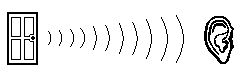
When a door is slammed, the door vibrates, sending sound waves through the air.
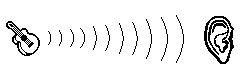
When a guitar string is plucked, the string vibrates the soundboard, which sends sound waves through the air.
What makes one sound different from another? To answer this question, we need to look at the waveforms of the two different sounds, to see the shape of their vibrations.
The waveform of a door slamming looks something like this:
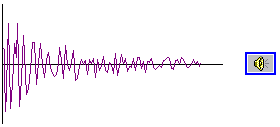
This waveform is jerky and irregular, resulting in a harsh sound. Notice how it is loud (with big waves) at the start, but then becomes soft (small waves) as it dies away.
The waveform of a guitar string looks something like this:
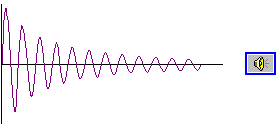
This waveform makes the same transition from loud to soft as the first, but otherwise is quite different.
The guitar string makes a continuous, regular series of repeated cycles, which we hear as a smooth and constant musical tone.
This regularity of the vibration is the difference between a musical sound and a non-musical sound.
|
Topic 5 of 117
| ||
Bring these music concepts to life with the free Songtrix Bronze Edition as you create songs from chords and scales.
Then publish and share your ideas with the other musicians you meet on the ChordWizard Network.

Have questions? Join the ChordWizard Network and post them in the Music Theory forum for answers and discussions on your topics of interest.