

(1.3) Amplitude and Frequency
There are two main properties of a regular vibration - the amplitude and the frequency - which affect the way it sounds.
Amplitude is the size of the vibration, and this determines how loud the sound is. We have already seen that larger vibrations make a louder sound.
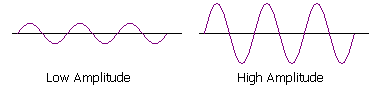
Amplitude is important when balancing and controlling the loudness of sounds, such as with the volume control on your CD player. It is also the origin of the word amplifier, a device which increases the amplitude of a waveform.
Frequency is the speed of the vibration, and this determines the pitch of the sound. It is only useful or meaningful for musical sounds, where there is a strongly regular waveform.
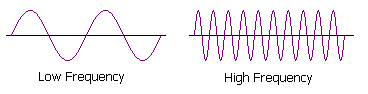
Frequency is measured as the number of wave cycles that occur in one second. The unit of frequency measurement is Hertz (Hz for short).
A frequency of 1 Hz means one wave cycle per second. A frequency of 10 Hz means ten wave cycles per second, where the cycles are much shorter and closer together.

The note A which is above Middle C (more on this later) has a frequency of 440 Hz. It is often used as a reference frequency for tuning musical instruments.
|
Topic 7 of 117
| ||
Bring these music concepts to life with the free Songtrix Bronze Edition as you create songs from chords and scales.
Then publish and share your ideas with the other musicians you meet on the ChordWizard Network.
Have questions? Join the ChordWizard Network and post them in the Music Theory forum for answers and discussions on your topics of interest.