

(2.2) Intervals of the Major Scale
The Major scale is by far the most common scale in western music. When played in sequence, the notes of the Major scale make the famous do-re-mi-fa-so-la-ti-do sound.
This characteristic sound of the Major scale is created by the pattern of intervals between its notes. There are seven notes in the Major scale and seven intervals between them. This pattern is:

When this pattern is used to extract notes from the Chromatic scale, we arrive at the Major scale.
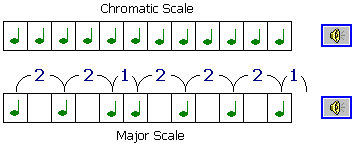
Adding the semitone interval sizes together (2+2+1+2+2+2+1) gives a total of 12, the number of semitones in a octave. This is also true for every other (non-Major) scale type.
The picture below shows how this pattern of intervals appears for the C Major scale on the piano.
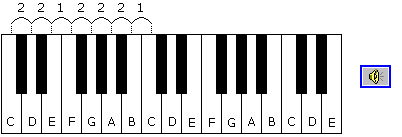
Notice how this interval pattern and starting note perfectly corresponds with the black and white keys of the piano, so that only white keys are used in the scale.
This is a special property of the C Major scale. Major scales starting on other notes need at least one black note, and in most cases several.
|
Topic 19 of 117
| ||
Bring these music concepts to life with the free Songtrix Bronze Edition as you create songs from chords and scales.
Then publish and share your ideas with the other musicians you meet on the ChordWizard Network.

Have questions? Join the ChordWizard Network and post them in the Music Theory forum for answers and discussions on your topics of interest.