
(2.4) Staff Line Notation
For centuries, the notes in pieces of music have been described by writing them on staff lines.
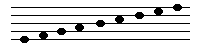
Staff notation is based on staves. A stave is a set of five horizontal lines, where each line (and each space in between) represents a different note letter. Note symbols are placed either on or between the lines.
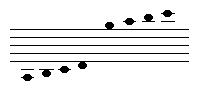
Extra notes can be accommodated outside these five lines, by adding extra leger lines (also spelled ledger) where needed.
There may be different arrangements of note letters on the staff lines, depending on which clef symbol appears at the start. There are only two clefs you really need to know.
The most important is the treble clef, which has note letters arranged as shown. It is sometimes called the G clef, because the inner twirl of the symbol centres on the line for note G.
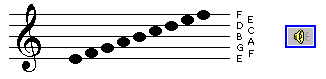
The notes of each line, from bottom to top, are E, G, B, D, F. You might find the phrase 'Every Good Boy Deserves Fruit' helpful for remembering this.
Also common is the bass clef, which has note letters placed as shown below. It is sometimes called the F clef, because the two dots are centred on the line for note F.
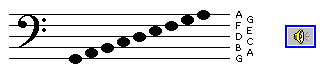
You can use the phrase 'Good Boys Deserve Fruit Always' to remember notes on the lines of the bass clef.
The treble and bass clef are often used together as a pair, covering a wider range of notes. They fit together neatly with a single leger line, used for Middle C, in between them.
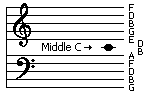
This is known as a grand stave, and the treble and bass staves are always joined with a vertical line at the left end, to show that they belong together.
In piano music, the left hand often plays the notes on the bass clef, while the right hand plays the notes on the treble clef.
Finally let's see how the C Major scale appears on staff lines. Shown below are two octaves of the C Major scale, centred on Middle C.


Most ChordWizard products contain the View Staff tool, or have a Track View which can show you how any scale or chord would appear on staff lines.
|
Topic 21 of 117
| ||
Bring these music concepts to life with the free Songtrix Bronze Edition as you create songs from chords and scales.
Then publish and share your ideas with the other musicians you meet on the ChordWizard Network.
Have questions? Join the ChordWizard Network and post them in the Music Theory forum for answers and discussions on your topics of interest.