
(2.7) G Major Scale on Staff Lines
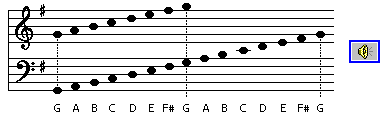
The notes of the G Major scale appear on staff lines as shown below. We can fit three octaves of G Major within the paired staff lines.
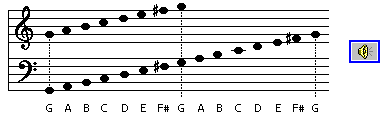
Every time a note appears on the F lines, the sharp (♯) symbol is put before it as an accidental, to show that it is really F♯.
Because F always means F♯ in the G Major scale, it is inconvenient to do this every time the note is used. Instead, a sharp can be placed at the start of every staff, to indicate that all F notes are to be played sharp.

This is known as the key signature of the G Major scale. Only one F line on each clef is marked in this way, even though the treble clef, for example, also has an F in the space between the bottom two lines.
The same three octaves of the G Major scale shown above can now shown more simply as follows.
The note F♯ would be called an accidental in the C Major scale, but not in this case, because it rightfully belongs to the G Major scale.
In fact, F natural is now the accidental, because it does not belong. The following shows how the note sequence E, F, F♯, G is written in the key of G.
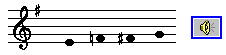
First the natural symbol is used as an accidental, to override the sharp of the key signature, and then the F needs to be 'resharpened' afterwards, with a sharp accidental.
Every key has a different key signature, as we will see shortly. The absence of a key signature always indicates the C Major scale.
All Major scales apart from C Major have at least one sharp or flat (and most of them have several) but there are no Major keys which have both sharps and flats in their key signature.
|
Topic 24 of 117
| ||
Bring these music concepts to life with the free Songtrix Bronze Edition as you create songs from chords and scales.
Then publish and share your ideas with the other musicians you meet on the ChordWizard Network.
Have questions? Join the ChordWizard Network and post them in the Music Theory forum for answers and discussions on your topics of interest.