
(2.11) Using Octave Clefs
Earlier we were introduced to the bass clef and the treble clef, which give us a reference point for which notes are represented by the lines of the stave.
Often, music will stray outside of these lines. We have seen that even the grand stave (bass clef + treble clef pair) has a range of only about three octaves, whereas the piano, for example, usually has a range of about seven octaves.
How then are we to write notes which would appear outside the staff lines? One way, mentioned earlier, is to use leger lines to extend the stave for particular notes.
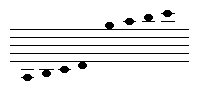
However, this is only useful up to about three legers, and even then only for temporary melodic excursions outside the stave. Extended passages written on legers, or large stacks of legers, are very hard to read.
A better solution is to use octave clefs. These are the same as regular bass or treble clefs, but they have one or more figure 8 symbols added above or below the clef to indicate that the notes on the clef are shifted by one or more octaves from what you would normally expect.
Let's see a few examples. The G Major scale written on a treble clef could appear like this:
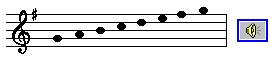
Suppose we wanted to play the same scale, but an octave higher. Then it would look like this, much less convenient to write and read:
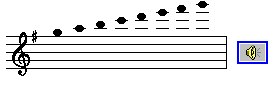
If we make an octave clef by joining a figure 8 to the top of the treble clef, this indicates the higher octave instead, allowing us to shift the actual note positions down onto the main stave lines again.
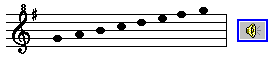
It works in the opposite direction, too. A figure 8 joined to the bottom of a treble clef indicates that notes are to be played an octave lower than normal. And for additional octave shifts, extra figure 8 symbols can be added above or below the clef as required.
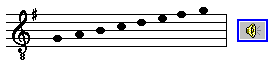

The same method can be used to shift the bass clef. If either the bass or treble clef in a grand stave is shifted using octave clefs, then both must be shifted by the same amount, to keep them compatible with each other.

ChordWizard products such as Songtrix manage the use of octave clefs automatically. Depending on the clef type and leger line count you have chosen for each part, they will adjust the octave of the clef to provide the optimum display of symbols on the stave.
|
Topic 28 of 117
| ||
Bring these music concepts to life with the free Songtrix Bronze Edition as you create songs from chords and scales.
Then publish and share your ideas with the other musicians you meet on the ChordWizard Network.
Have questions? Join the ChordWizard Network and post them in the Music Theory forum for answers and discussions on your topics of interest.