

(2.12) The Circle of Fifths
The previous topics demonstrated an important relationship between a Major scale, and the Major scale which starts on its fifth note - it is the same, but one note is sharpened (or one less note is flattened).
This is a special characteristic of the Major scale. The same thing can be illustrated with the circle of fifths, where the 12 keys of the Major scale are arranged like a clock, with C Major at the top.
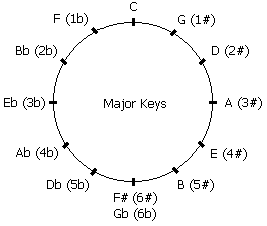
As you move clockwise around the circle, each key note is the fifth note of the key before it (giving the circle its name), and each key has one more sharp note, or one less flat note, than the key before it.
As you see, the keys appear in the same order as they did in the earlier table, and as they did with the key signatures.
At the bottom of the circle, the anti-clockwise series of keys with flat notes, and the clockwise series of keys with sharp notes, join at F♯=G♭. They give us two alternate ways to look at this key.
If we call it F♯ Major, then it has six sharp notes. If we call it G♭ Major, then it has six flat notes. In either case, the notes in the scales are the same, and only the names are changing to fit the name of the key note.
If we compare the note names in these two scales, we find they match perfectly as the same notes:

Notes like this, which are the same but have different names, are called enharmonic notes.
The same situation also exists if we extend the overlap in the circle of fifths on either side. So, for example:



In ChordWizard products, when strict note naming is active, the names of the notes within scales are automatically chosen to suit the name of the root note.
|
Topic 29 of 117
| ||
Bring these music concepts to life with the free Songtrix Bronze Edition as you create songs from chords and scales.
Then publish and share your ideas with the other musicians you meet on the ChordWizard Network.
Have questions? Join the ChordWizard Network and post them in the Music Theory forum for answers and discussions on your topics of interest.