
(3.2) Interval Names
Interval names are based on the notes of the Major scale, where the lower note of the interval takes the place of the root note (starting note) of the Major scale.
For example, the upper note in an interval of two semitones corresponds to the second note of the Major scale. This interval is called a second or more precisely, a major second.
The upper note in an interval of four semitones corresponds to the third note of the Major scale, so this interval is called a third, or major third.
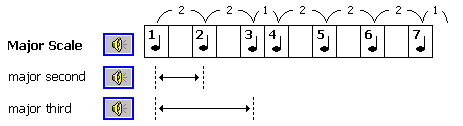
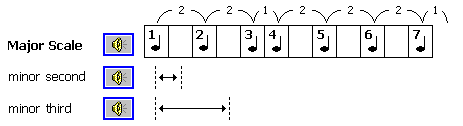
The use of the word major is important, because there are also minor second (one semitone) and minor third (three semitones) intervals.
These intervals have no corresponding note in the Major scale, so the modifier minor is used to reduce the size of the next larger interval by one semitone.
The term diminished also means to reduce by a semitone, and augmented means to increase by a semitone. The term perfect explicitly indicates an interval which has not been modified, and is usually only applied to the fourth or fifth.
The tritone interval has a size of six semitones, or three tones. It sits on the halfway mark in the octave, so it has the special property of still being a tritone when turned 'upside down' (raising the lower note, or lowering the upper note, by an octave).
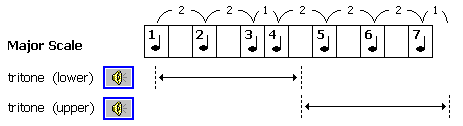
Intervals with no exact note in the Major scale can often have alternate names, depending on whether you choose to augment the interval below or diminish the interval above. For example, the tritone interval can also be called an augmented fourth or a diminished fifth.
Above the first octave, interval names are formed by continuing the count of the Major scale notes into an extra octave.
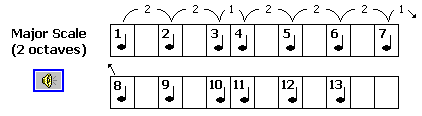
These extended intervals are essentially repeats of the first octave intervals, but with a slightly different effect because of the extra octave of separation.
The octave interval itself is an eighth, a name which is rarely used in practice, but reveals the origin of the word 'octave'.
The major ninth falls on the same note as the major second, the major tenth on the same as the major third, while the other intervals pair up as the fourth/eleventh, fifth/twelfth and sixth/thirteenth.



Intervals of up to the major thirteenth are commonly used in the construction of chords.
|
Topic 32 of 117
| ||
Bring these music concepts to life with the free Songtrix Bronze Edition as you create songs from chords and scales.
Then publish and share your ideas with the other musicians you meet on the ChordWizard Network.
Have questions? Join the ChordWizard Network and post them in the Music Theory forum for answers and discussions on your topics of interest.