
(3.5) Degrees and Notes
It is important to be comfortable with the difference between the degrees and notes of a chord.
Degrees indicate how the intervals of a chord type contribute to its overall sound, regardless of the root note. They do not correspond directly to notes until a root note is chosen, and the chord type becomes a chord.
The degrees could correspond to twelve different sets of notes, depending on the root note. We created the Cmaj chord in the previous topic, but we can also build a major chord on any other root note.

Some ChordWizard products use overlay labels to show where the notes and degrees of a particular chord or scale occur on an instrument. You can select whether these labels should display note names or the equivalent degree names.
The table below shows how degrees become notes for all possible major chords. You might find it interesting to compare these with the table of all Major scales shown earlier.
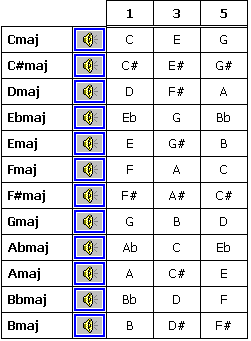
You can see that a note can have differently names in different chords. Bmaj contains the note D♯, taken from the B Major scale, while the same note is called E♭ when it appears in A♭maj, taken from the A♭ Major scale.
As with the Major scale, the name of the root note also affects the names of the other notes, even when the chord is otherwise exactly the same.
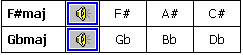
In ChordWizard products, when strict note naming is active, the names of the notes within chords are automatically chosen to suit the name of the root note.
|
Topic 35 of 117
| ||
Bring these music concepts to life with the free Songtrix Bronze Edition as you create songs from chords and scales.
Then publish and share your ideas with the other musicians you meet on the ChordWizard Network.
Have questions? Join the ChordWizard Network and post them in the Music Theory forum for answers and discussions on your topics of interest.