
(3.8) Harmonic Extensions
Extended chords are the chord types of four or more notes which are formed by adding extra notes to a triad. There are many combinations of extra notes which can be added.
An important series of chord types, known as harmonic extensions, can be formed by adding odd-numbered degrees to the major triad.
The major triad itself is made from the first three odd-numbered degrees. There is a special harmonic relationship between the frequencies of the odd-numbered degrees (1, 3, 5, ♭7, 9, 11, and 13).
Here are the chord types formed by the harmonic extension of the major triad.
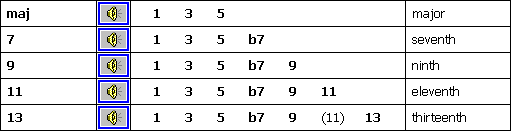
Note that this series contains the flat seventh degree (also called dominant seventh) rather than the natural seventh. With chords, the flat seventh is so common that it is simply called the seventh, and the natural seventh is called the major seventh to distinguish it.
The 11th degree (shown in brackets) is often omitted in chords which include the 13th degree.
|
Topic 38 of 117
| ||
Bring these music concepts to life with the free Songtrix Bronze Edition as you create songs from chords and scales.
Then publish and share your ideas with the other musicians you meet on the ChordWizard Network.
Have questions? Join the ChordWizard Network and post them in the Music Theory forum for answers and discussions on your topics of interest.