
(4.6) Blues Scale
Blues is a very important area of modern music. It is usually considered the forerunner of both jazz and rock, and it breaks many of the conventions of classical music theory.
Blues music has a solid but plaintive sound which results from the use of a minor-based scale over the top of major-based chords (usually dominant sevenths). When we look at relating chords and scales a little later, you will see how unusual this is.
In particular, the Blues scale is a very common choice for melodies and improvisations in blues music.

The Blues scale has only six notes - unlike all the other scales we have seen so far with seven. It is also unusual in that some of its notes are considered blue notes, meaning that they are not played exactly at the pitch you would expect.
In the C Blues scale, for example, the note E♭ is often played slightly sharp, somewhere between E♭ and E. The notes G and B♭ are also sometimes played slightly off their expected pitch.
For this reason the voice and the guitar, which can both bend the pitch of their notes, are heavily used in blues music.
There are several standard chord progressions in blues music, and they all use dominant seventh chords based on the 1st, 4th and 5th notes of the Major scale.
For example, a song in the C Blues scale would mainly use the chords C7, F7 and G7, and the notes of these are shown below.
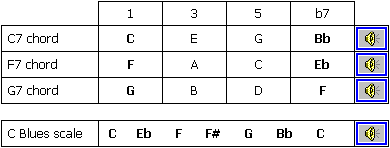
The Blues scale fits well with all of these chords because it contains the defining root note and flat seventh note of each one of them. It also contains F♯, a tritone away from the key note of C.
Tritones are very important intervals for adding tension to music. It is the tritone interval between the degrees 3 and ♭7 that create the characteristic sound of the dominant seventh chord.
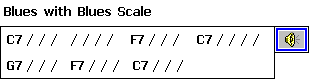
Now let's see how this all fits together by playing a typical blues chord sequence in the key of C, with the C Blues scale over the top.
|
Topic 52 of 117
| ||
Bring these music concepts to life with the free Songtrix Bronze Edition as you create songs from chords and scales.
Then publish and share your ideas with the other musicians you meet on the ChordWizard Network.
Have questions? Join the ChordWizard Network and post them in the Music Theory forum for answers and discussions on your topics of interest.