
(4.11) Symmetric Scales
Symmetric is the word used to describe scales (and chords) where more than one root note will result in the same set of notes. There are several different types.
For example, the C Whole Tone scale contains the notes C-D-E-F♯-G♯-A♯, while the D Whole Tone scale has the same notes, just in a different order (remembering that B♯=C). These same notes appear in the E, F♯, G♯ and A♯ Whole Tone scales.
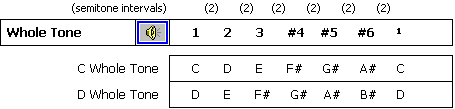
In fact, there are only two distinct Whole Tone scales, consisting of the alternate sets of six notes.
The Diminished scale is slightly more complex in nature and sound, with alternating semitone and tone intervals. This scale can produce three distinct sets of notes, depending on the root note.

It is closely related to the diminished seventh chord, which has four notes each at intervals of three semitones from each other. It has a degree marked ♭♭7 instead of 6, because it the 'diminishing' of the ♭7 interval that provides the name for the scale and the chord.
Also, as you might guess, there is an Augmented scale which, in the same way, is closely related to the augmented chord.

The symmetric scales are rarely used for whole melodies or prolonged periods of improvising, because their regular intervals do not fit well with the Major scale or with any of the minor scales.
However, they can be effective when improvising for adding brief passages of tension. They also play a useful role for improvising over a key change, since they can partially fit with two different Major or minor scales at the same time.

Most ChordWizard products contain the Scale Synonyms tool. This identifies and allows you to explore scale modes, and symmetric scale types which produce identical sets of notes.
|
Topic 57 of 117
| ||
Bring these music concepts to life with the free Songtrix Bronze Edition as you create songs from chords and scales.
Then publish and share your ideas with the other musicians you meet on the ChordWizard Network.
Have questions? Join the ChordWizard Network and post them in the Music Theory forum for answers and discussions on your topics of interest.