
(4.12) Other Exotic Scales
While we looked at the Japanese and Spanish scales in some detail earlier, there are also many other exotic scales originating from music of Eastern Europe, Asia and the Middle East.
Although they don't often appear directly in western music, they are powerful ingredients for adding melodic and harmonic spice to 'plain vanilla' western music.
Some of the most common examples you are likely to find are shown below. When played, they can evoke strong echoes of the traditional or contemporary music of their respective cultures.





Even though these scales sound very different from the Major scale, they still share the property of having seven notes. The names of their degrees are therefore chosen carefully, so each of the seven note letters (A to G) is used once.
In other words, the fourth note of the C Hungarian Minor scale is called F♯ - not G♭ - because there is already a G as the next note up. This makes it easier to write melodies in these scales on staff lines, but there are still likely to be many accidentals.
It would seem possible to make up your own 'irregular' key signatures to suit any seven-note scale (including the Harmonic Minor, Melodic Minor, and Spanish). For example, here is one to suit C Hungarian Minor.
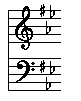
You need to exercise extreme caution with these, however, as classical music theory insists that only the Major key signatures are valid, and your 'irregular' key signatures would not be widely understood by other players.

ChordWizard products allow you to activate or deactivate any of the supplied standard scale types. Only the active scale types are displayed and used.
This means that you can customise these products for the scale types you are interested in. You can also extend them by adding your own custom scale types which are then seamlessly integrated into all operations.
|
Topic 58 of 117
| ||
Bring these music concepts to life with the free Songtrix Bronze Edition as you create songs from chords and scales.
Then publish and share your ideas with the other musicians you meet on the ChordWizard Network.
Have questions? Join the ChordWizard Network and post them in the Music Theory forum for answers and discussions on your topics of interest.