
(5.1) Note Lengths
It is obvious that in music, notes of many different lengths are played. Consider the passage below, composed by Rimsky-Korsakov. The melodic notes are very short and fast, while the harmonic (chord) notes are longer and fewer.

What may not be so obvious is how dramatically the lengths of the notes can affect the melody of a piece of music. Shown below are three variations on a melody. The original is easily recognized as Mary Had A Little Lamb. The other two contain the same notes, in the same sequence, but with different lengths.
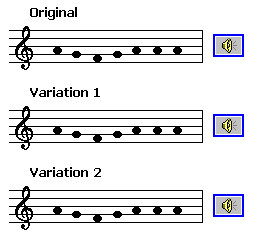
You will agree the variations sound very different from the original melody, as if they belong to a different song. And yet they look the same if they are notated without indicating their note lengths.
Clearly, the shorthand notation we have used so far in these tutorials is not adequate for accurately describing a piece of music. Staff notation has a range of symbols for showing note length, using a combination of hollow and solid noteheads, stems, and flags.
In fact, the simple black notehead is not a proper staff notation symbol at all. This makes it perfect to indicate where no attempt at showing note lengths has been made.
We will still use it where timing is not important, such as discussing the notes of a single chord. But from now on, we will be notating most of our musical examples fully, using the correct staff symbols to show the lengths of the notes.
|
Topic 60 of 117
| ||
Bring these music concepts to life with the free Songtrix Bronze Edition as you create songs from chords and scales.
Then publish and share your ideas with the other musicians you meet on the ChordWizard Network.
Have questions? Join the ChordWizard Network and post them in the Music Theory forum for answers and discussions on your topics of interest.