
(5.6) Note Flags and Beams
The convention of adding flags to note symbols of less than a quarter note to halve their length is easy to understand, but it can have the effect of making them hard to read, especially when several of them are clustered together.
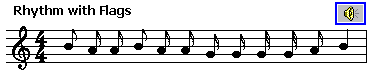
For example, the rhythm below has so many flags that it takes long and careful examination to get a sense of the pattern.
Flagged notes on their own must always use flags, but where more than one appears next to each other, readability can be improved by replacing the flags with beams that join the notes together into a grouping.
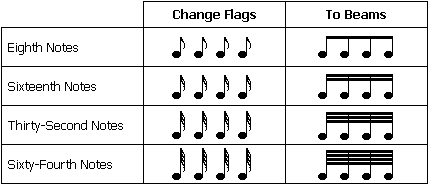
Single flags are replaced with single beams, double flags are replaced with double beams and so on, as illustrated below.
Notes of different lengths can also be joined in this way, as long as they are all less than a quarter-note (in other words, they all have flags). Each grouping must finish wherever there is a note without a flag, and usually wherever there is a rest. Let's look at some examples.
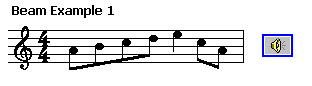
Here we have two groupings, which have been broken by the presence of an (unflagged) quarter-note between them. Notice how the slant of the beams reflects the vertical distance between the notes. This reinforces the shape of the melody, so it's easier and more comfortable to read.
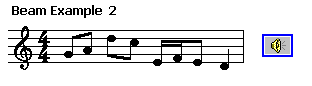
Here the groupings have been forced to break (twice) by the change in orientation of the note stems. Notice how the eighth- and sixteenth-notes share a grouping with combined single/double beams.

Here there is also a grouping with combined single/double beams, but the double beams are limited to a single note each. The short secondary beam normally aligns with the notehead, but with the first note in the grouping, this is not possible, so it appears to the right.
So now let's return to the original rhythm at the start of this topic, and rewrite it using beams.
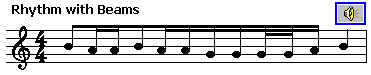
It looks better, although with so many notes, the grouping itself is looking quite unwieldy. We can improve it further by voluntarily breaking this large grouping into smaller groupings.
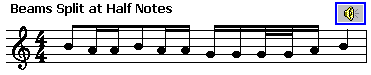
Groupings should be broken at whichever point gives the clearest indication of timing within the bar. Depending on the meter and the lengths of the beamed notes, this will typically be on half-note or quarter-note boundaries.
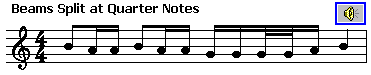
For our example, we could break at the halfway point in the bar, or at every quarter-note. Either way, we get a much more readable notation of the rhythm.

ChordWizard products such as Songtrix offer three modes of Flag Beaming when they prepare staff notation for you.
- You can prevent beaming, in which case all notes are drawn with flags as required.
- You can beam within Whole Bars in which case a single grouping is attempted if possible.
- You can beam to Sub Bars in which large groupings are broken up at regular boundaries within the bar (depending on the meter).
|
Topic 65 of 117
| ||
Bring these music concepts to life with the free Songtrix Bronze Edition as you create songs from chords and scales.
Then publish and share your ideas with the other musicians you meet on the ChordWizard Network.
Have questions? Join the ChordWizard Network and post them in the Music Theory forum for answers and discussions on your topics of interest.