
6) Chord/Scale Relations
As well as providing a set of notes for creating melodies, scales can help us find chords which suit the key of a piece of music.
Several times so far, we have indicated that certain chords are suited to particular scales more than other chords. In fact, every chord is related to several scales, and every scale is related to several chords.
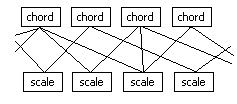
There is an rich web of relationships between chords and scales, and understanding how to use them is very important for many aspects of music, especially with improvisation and songwriting.
When improvising over a particular chord progression, we can find related scales which are suitable for playing with the individual chords or the entire progression.
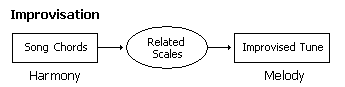
In other words, the harmonic structure of the chord progression gives us guidance for creating the melody.
When songwriting in a particular key or scale, we can find related chords which are likely to be good choices to support the melody and help us build a chord progression.
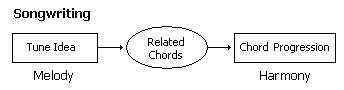
In other words, the melodic structure of the song's scale gives us guidance for creating the harmony.
Both of these processes are covered in more detail later. In this tutorial we are going to examine how different chords and scales are related to each other, by the notes that they share in common.

Some ChordWizard products have a Relations View gives you a powerful way to explore how scales and chords are related to each other.
Further options are available using the popup Relations tool instead, which is contained in most ChordWizard products.
Using these tools, you will be able to confirm all of the examples in this tutorial, and also experiment beyond them with other chord and scale types.
|
Topic 70 of 117
| ||
Bring these music concepts to life with the free Songtrix Bronze Edition as you create songs from chords and scales.
Then publish and share your ideas with the other musicians you meet on the ChordWizard Network.
Have questions? Join the ChordWizard Network and post them in the Music Theory forum for answers and discussions on your topics of interest.