
(6.2) Scale Tone Triads
The principle of relating chords to scales is essentially quite simple:
Any chord made entirely from scale tones (and not having any notes from outside the scale) is related to the scale, and is likely to suit a piece of music written in the scale.
The most important related chords are those which are constructed with the root note as one of the scale tones, and the other notes being added from every second scale tone above it.
We need at least three notes to make a chord, so let's first explore building triad chords from the scale tones of C Major, which consists of the notes C-D-E-F-G-A-B.
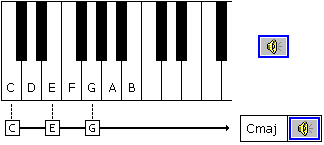
If we take every second scale tone starting from C, we get the three notes C-E-G. These are the notes of the chord Cmaj, which (not surprisingly) is highly compatible with the C Major scale, so much that it often starts and ends songs written in this key.
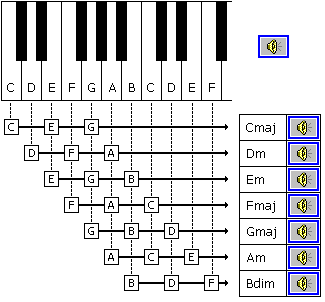
We can get seven triad chords in this way by starting from each of the other scale tones as well. This gives us Dm (= D+F+A), Em (= E+G+B) and so on. Each of these are relations of the C Major scale.
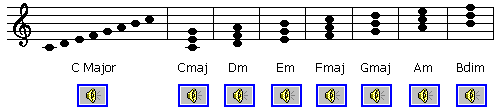
These same seven triads can be represented in staff notation as follows.
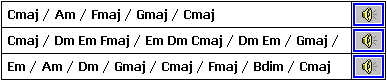
Try playing these seven chords in different sequences and you will soon get a sense of how compatible they are with each other. Here's a few examples that may sound familiar.
|
Topic 72 of 117
| ||
Bring these music concepts to life with the free Songtrix Bronze Edition as you create songs from chords and scales.
Then publish and share your ideas with the other musicians you meet on the ChordWizard Network.
Have questions? Join the ChordWizard Network and post them in the Music Theory forum for answers and discussions on your topics of interest.