
(6.11) Roman Numeral Notation
The roman numeral notation for scale tones, introduced at the start of this tutorial, gives us a convenient way to represent related chords regardless of which key the scale is in.
Although it may seem a little strange at first, it is worth getting used to this notation. It allows us to discuss the movement of harmony in general terms, without always needing to draw an example from a specific key.
Remember that the roman numerals correspond directly to degree numbers, which in turn are based on the Major scale. Let's see how it works in practice.
The table below shows the related chords of the Major scale, using roman numeral notation. This is effectively identical to the earlier table of related chords of C Major, except that we no longer need to tie these chords to the key of C.
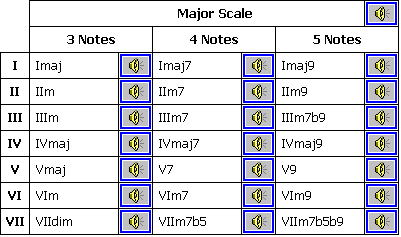
With the related chords of the Major scale expressed in this way, we can more easily find related chords for any key.
For example, the table tells us that the chords IVmaj, IVmaj7 and IVmaj9 are related to the Major scale. Let's pick a Major scale, say F Major (containing the notes F-G-A-B♭-C-D-E).
The key of F has a fourth (IV) note of B♭, so we now know that the F Major scale has the related chords B♭maj, B♭maj7 and B♭maj9.
Roman numeral notation can be used to express the related chords of the Melodic Minor and Harmonic Minor scale as well.
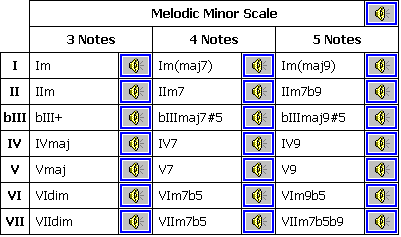
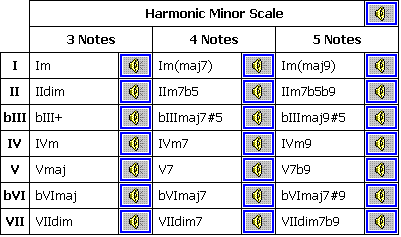
Notice the use of ♭III (equivalent to the ♭3 degree) and ♭VI (equivalent to the ♭6 degree) for the non-Major intervals in these scales.
|
Topic 81 of 117
| ||
Bring these music concepts to life with the free Songtrix Bronze Edition as you create songs from chords and scales.
Then publish and share your ideas with the other musicians you meet on the ChordWizard Network.
Have questions? Join the ChordWizard Network and post them in the Music Theory forum for answers and discussions on your topics of interest.