
7) Playing with Chords
Earlier, we looked at how chords are constructed, and then examined some of the most useful chord types. This tutorial covers the practical issues that arise when we play chords in a real musical setting.
Musical instruments can be broadly divided into monophonic instruments, which can play only one note at a time, and polyphonic instruments, which can play several notes at a time.
Some examples of each type are listed below. Classical string instruments such as the violin are usually monophonic, although they can play two notes at once at a pinch.
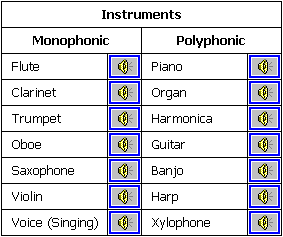
Monophonic instruments can only play chords in a group setting, such as an ensemble or an orchestra, where each instrument would play one of the notes of the chord.
Polyphonic instruments can play chords entirely on their own, but they often do not have the freedom to play them in exactly the way they were presented earlier.
For example, chords on the piano are usually played with one hand (while the other hand plays the melody), so only five fingers are available for chords. Instruments such as the ukulele are even more restrictive, since they only have four strings in total.
To play five- or six-note chords (such as maj9 or m11) on these instruments, a compromise must be made by leaving out one (or more) of its notes.
Chords are often rearranged in other ways to suit particular instruments, or a particular piece of music, even with ensembles of monophonic instruments. We will look at each of these cases in turn.

Most ChordWizard products contain a collection of standard chord types, including those in this topic, and provide powerful tools for working with chords of all types.
These include tools for exploring how chords are played on your instrument, identifying the names of chords you have discovered, and printing chord book reports.
|
Topic 83 of 117
| ||
Bring these music concepts to life with the free Songtrix Bronze Edition as you create songs from chords and scales.
Then publish and share your ideas with the other musicians you meet on the ChordWizard Network.
Have questions? Join the ChordWizard Network and post them in the Music Theory forum for answers and discussions on your topics of interest.