

(7.2) Chord Inversions
So far we have been building chords with notes formed by lining up the degrees in order, starting with the root note.
For example, building a C7 chord (with degrees 1-3-5-♭7) gives us the notes C-E-G-B♭, where each note is a higher pitch than the one before it.
If we move the note C up one octave, the same notes are present, but the sequence of pitches is now E-G-B♭-C. Is this still a C7 chord?
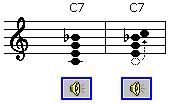
Yes it is, and this arrangement of notes is known as an alternative inversion (or voicing) of the same chord.
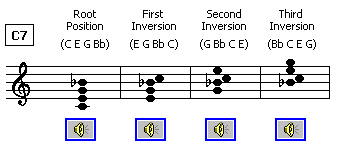
There are several inversions possible for a chord, and obviously more for chord types with more notes. The standard arrangement of a chord (with notes in degree order) is called root position.
Moving the lowest note to the top creates the first inversion. Repeating this creates the second inversion, and so on.
All of the standard inversions of C7 are shown below. They all have the same overall sound, but with various shades of color from the different combinations of frequency multiples.
Alternate inversions are often used to create a smoother transition from one chord to the next, by avoiding large jumps in pitch.
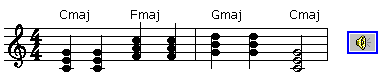
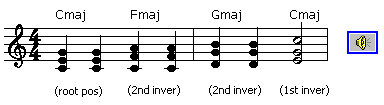
Compare the two different versions of the simple chord sequence below. In the first version, the chords are all in root position, while in the second, alternate inversions are used instead to create a stronger, more continuous sound.
|
Topic 85 of 117
| ||
Bring these music concepts to life with the free Songtrix Bronze Edition as you create songs from chords and scales.
Then publish and share your ideas with the other musicians you meet on the ChordWizard Network.

Have questions? Join the ChordWizard Network and post them in the Music Theory forum for answers and discussions on your topics of interest.