
(7.3) Slash Chord Notation
Often a composer or arranger of sheet music will want to specify which inversion of a chord should be used in a particular place.
In these cases, the long-hand terms of root position, first inversion, etc, can be quite clumsy. Instead, slash chord notation is used to indicate which note is the bass note in the inversion.
For example, the term Cmaj/G means the Cmaj chord with G as the bass note. In other words, the notes are arranged in the order G-C-E.
Here again are the inversions of C7 shown in the previous topic, this time expressed in slash chord notation. If no bass note is specified, the root position (or the player's choice of inversion) is assumed.
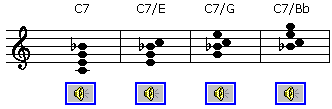
As you can see, this is a much more compact way of showing which inversion a chord is arranged in. Also, it is usually easier for players to see exactly which note their chord should start on, rather than having to work it out from an inversion number.
As another example, the chord sequence of the previous topic has been rewritten below, using slash chord notation.
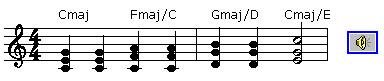

ChordWizard products support the use of slash chord notation wherever appropriate, allowing you to specify not just the chord, but also the inversion you want to use.
In general, you should only specify, after the slash, one of the notes which is already part of the chord. This sounds obvious, and yet you will occasionally come across a chord expressed something like Dmaj/B.
In this case, B is not one of the notes of Dmaj (=D+F♯+A), and the expression Dmaj/B is simply telling you to play the Dmaj chord in root position, with an additional B note below it.
This form of use has the problem of being misleading, because adding a B to the Dmaj chord changes it into a different chord, in this case D6 (=D+F♯+A+B). So a more accurate expression of the same thing would be D6/B.

Sometimes arrangers have a particular reason for writing slash chords in this way, perhaps to emphasize the essential Dmaj sound of the music if B is a transient passing note.
But in general, it is better to name the total chord clearly and accurately to avoid these hidden adjustments.
|
Topic 86 of 117
| ||
Bring these music concepts to life with the free Songtrix Bronze Edition as you create songs from chords and scales.
Then publish and share your ideas with the other musicians you meet on the ChordWizard Network.
Have questions? Join the ChordWizard Network and post them in the Music Theory forum for answers and discussions on your topics of interest.