

(7.4) Other Inversions
All of the chord inversions we have so far looked at contain the notes appearing in a consecutive sequence. They are known as close position inversions.
Other inversions, with notes spread across more than a single octave, are also possible and these are known as open position inversions.
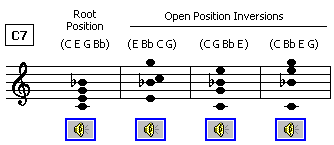
For example, an open position inversion of the C7 chord could be made from the sequence E-B♭-C-G, where a possible G between the E and B♭, and a possible E between the C and G have not been played.
This inversion is shown below, together with two other open position examples. Notice how they still make a recognisable C7 sound, but they have a much wider, spacier feel.
Open position chord inversions tend to appear most often in orchestras and ensembles, where the different pitch ranges of the various instruments can cover the wider spread of notes.
They can be hard to achieve on a single instrument such as the piano, where the large intervals involved create too much of a stretch for a single hand to cover.
In fact on the piano, other inversions are more likely to appear as a result of collapsing extended chords into a single octave, to reduce this stretch.
Take the C9 chord for example. In root position, this contains the notes C-E-G-B♭-D, creating a stretch on the keyboard which is a hurdle for even the largest of hands.
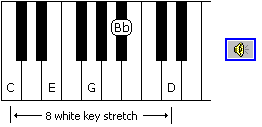
This stretch can be reduced, without losing any notes, if we raise the bottom C by an octave. The stretch has now been reduced from eight to a more manageable six white keys, with only a slight change to the overall sound.
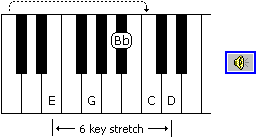
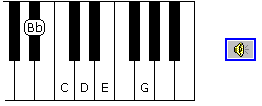
When collapsing chords like this, you should generally raise the lower notes, rather than lowering the upper notes. Try to keep the higher degrees of the chord (7, 9, 11, etc) among the highest pitched notes, otherwise their effect can become indistinct and muddy.
Compare the sound of this (not so good) inversion of C9 with the two shown above.

ChordWizard products take care of evaluating inversions for you, by automatically ranking matching chords for a group of notes. Those chords where the degree order aligns closest with the pitches of the notes will rank more highly.
|
Topic 87 of 117
| ||
Bring these music concepts to life with the free Songtrix Bronze Edition as you create songs from chords and scales.
Then publish and share your ideas with the other musicians you meet on the ChordWizard Network.
Have questions? Join the ChordWizard Network and post them in the Music Theory forum for answers and discussions on your topics of interest.