
(7.5) Synonym Chords
Exploring inversions raises an interesting point.
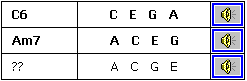
Consider the notes of the chord C6 (degrees 1-3-5-6), which are C-E-G-A. Now consider the notes of the chord Am7 (degrees 1-♭3-5-♭7), which are A-C-E-G.

The notes are the same! In other words, Am7 is simply an inversion of C6 and vice-versa. Likewise, B♭m7 is an inversion of C♯6, Bm7 is an inversion of D6 and so on.
These are known as synonym chords. There are several other chord types which cross paths like this, including:



The third example is the most curious, where the 7♭5 chord type corresponds to itself with a different root note. This behaviour comes from the two tritone intervals in the formula (between 1-♭5 and between 3-♭7).
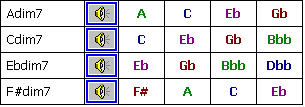
The symmetric chord types dim7 (diminished seventh) and + (augmented) are an even more special case, where each chord has multiple synonyms of the same type (eg. Adim7, Cdim7, E♭dim7 and F♯dim7 all contain the same notes).
Deciding which chord name to put on a set of notes which make synonym chords can be difficult. If the chord types are different, you can sometimes get a clue from whether the chord sounds more like, for example, a C6 or an Am7.
Otherwise, the best strategy is to use the name of the chord whose root note is the lowest pitch, or whose upper degrees are the highest pitch, among the notes.
If for example, the set of notes from C6/Am7 were arranged by increasing pitch as C-G-A-E, this does not fit the root positions of either chord. You would call it C6, recognising that the lowest note C is acting most strongly as the root note.
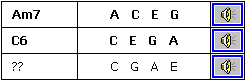
If they were arranged as A-C-G-E, you would call it Am7, because the lowest note A is acting most strongly as the root note.

Most ChordWizard products contain the Chord Synonyms tool. This identifies and allows you to explore symmetric chord types, and also the other chord types which are inversions of each other, producing identical sets of notes.
|
Topic 88 of 117
| ||
Bring these music concepts to life with the free Songtrix Bronze Edition as you create songs from chords and scales.
Then publish and share your ideas with the other musicians you meet on the ChordWizard Network.
Have questions? Join the ChordWizard Network and post them in the Music Theory forum for answers and discussions on your topics of interest.