

(7.6) Repeating Notes
When playing chords on a stringed instrument such as the guitar, the physical limitations of your fingers on the fretboard often make the root inversion difficult to form, so many of the normal chordshapes use an alternate inversion.
Even when a root position formation is possible, it can be useful to add repeated appearances of some notes in the chord, an octave or two apart.
This adds to the fullness of the sound, but it can slightly alter the overall harmonic coloring. Compare the sounds of the Cmaj chord below, first in root position, then with repeated notes added.
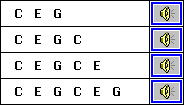
Let's see how this works in practice with the guitar (in standard tuning). We can form a Cmaj chord in root inversion using only three of its six strings, as shown below. The dotted lines are mute strings, which are not played.
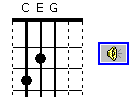
However, using only three strings sounds a little thin on the guitar, and it also make the chordshape harder to play because we need to avoid the mute strings.
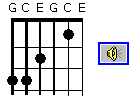
A better arrangement is to play, on the other strings, repeats of some notes from the chord. Then we get an easy strum which has a fatter sound.
|
Topic 89 of 117
| ||
Bring these music concepts to life with the free Songtrix Bronze Edition as you create songs from chords and scales.
Then publish and share your ideas with the other musicians you meet on the ChordWizard Network.

Have questions? Join the ChordWizard Network and post them in the Music Theory forum for answers and discussions on your topics of interest.