

(7.7) Missing Notes
When playing chords on fretted string or keyboard instruments, you may sometimes need to leave out some of the notes of the chord.
For example, pianists usually only have the five fingers of one hand available for making chords, and ukulele players are limited to the four strings of their instrument. This makes it difficult or impossible to play five- or six-note chords completely.
In situations like these, you need to be careful which note(s) you leave out, otherwise the sound of the chord can lose its harmonic clarity, making the music feel bland or ambiguous.
To illustrate, compare the sounds of the complete C7 chord below, against the sound it makes when each of its notes is left out.
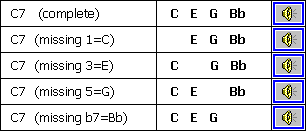
You should find that the forms of C7 missing 1=C, and missing 5=G sound closest to the full C7.
In general, the root and 5th degrees can be most easily omitted from chords without losing the characteristic sound of the chord type.
This is because they are such basic elements of most chord types that your ear tends to anticipate them, even when they are not played.

ChordWizard products automatically deal with inexact matching chords for a group of notes, ranking them below the exact matching chords. The missing notes of each chord are shown in terms of both their note and degree names.
|
Topic 90 of 117
| ||
Bring these music concepts to life with the free Songtrix Bronze Edition as you create songs from chords and scales.
Then publish and share your ideas with the other musicians you meet on the ChordWizard Network.

Have questions? Join the ChordWizard Network and post them in the Music Theory forum for answers and discussions on your topics of interest.