
(7.8) Required Degrees
Some degrees can be omitted from chords with very little impact on the final sound, but others play a more important role which can badly affect the sound of the chord if they are missing.
These can be called required degrees. The distinction between required and optional degrees is not black and white, but the guidelines below will help you understand the issues involved.
1. The root (1) and fifth (5) degrees are usually dispensable, particularly in a group situation where other instruments are often covering the notes you are missing. The sounds in the previous topic demonstrate this.
2. The third degree (♭3 or 3) of a chord should always be present, since it defines the major or minor character of the chord. Notice the ambiguous sound of the example below. It is major or minor?
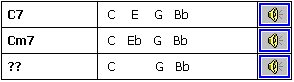
2. The seventh degree (♭7 or 7), where it exists in the chord type, should also be present. The interaction of the third and seventh degrees provides the harmonic basis for extended chords. Notice the loss of strength by omitting the ♭7 from the C11 chord below.

4. Explicitly named degrees should always be present. For example, the C9 chord should contain the 9 (= D) degree, otherwise you are simply playing a C7.

5. Distinctive degrees that differentiate chord types should always be played. For example, the chord type m9 (degrees 1-♭3-5-♭7-9) is the same as madd9 (degrees 1-♭3-5-9) except for its extra ♭7 degree, which therefore should not be omitted.


ChordWizard products use the concept of required degrees, which must be present in matching chords.
The required degrees of the standard chord types are carefully chosen to follow these guidelines. This means that you will always be working with the most appropriate matching chords.
|
Topic 91 of 117
| ||
Bring these music concepts to life with the free Songtrix Bronze Edition as you create songs from chords and scales.
Then publish and share your ideas with the other musicians you meet on the ChordWizard Network.
Have questions? Join the ChordWizard Network and post them in the Music Theory forum for answers and discussions on your topics of interest.