
(7.10) Substitution for Effect
Another reason for substituting chords is to add interest to a piece of music. This process in the previous topic can be taken the other way, for the opposite effect.
If you are starting off with a rather bland chord progression, you can add chord extensions and extra chords to spice it up. Take the following progression for example, which has a particularly dull stretch of Cmaj.

We can do a complete makeover here by adding harmonic extensions to the existing chords and inserting extra chords to break the monotony.

Most of these extra chords (such as C6 and Cmaj7) are simply based on the original chord (Cmaj). However, a very effective double change (C♯m7♭5-A7-Dm) now leads into the Dm section.
The A7 to Dm creates a V7-Im harmonic movement which, as discussed in the previous tutorial, is a strong one. The C♯m7♭5 acts as a bridge to get us to the A7 from the C-based chords.
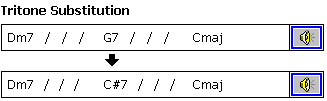
Another magical substitution trick is known as tritone substitution, and it usually works best on 7 (dominant seventh) chords. The idea is that in certain situations, a 7 chord can be replaced by the 7 chord with root note one tritone away.
For example a G7 can be replaced by a C♯7, as shown below. This adds a jazzy, chromatic flavour to an otherwise predictable chord sequence.
|
Topic 93 of 117
| ||
Bring these music concepts to life with the free Songtrix Bronze Edition as you create songs from chords and scales.
Then publish and share your ideas with the other musicians you meet on the ChordWizard Network.
Have questions? Join the ChordWizard Network and post them in the Music Theory forum for answers and discussions on your topics of interest.