
(8.7) More on Major Scale Modes
In the previous topic we saw how the modes of the Major scale make it easy to find an appropriate scale for improvising over a maj chord.
In fact we can apply the same process to the other chord types as well, starting with other triads.
Let's try it with the minor (m) triad chord, which has the degrees 1-♭3-5. We simply look for the Major scale modes which contain these degrees, and we find three of them, as shown below.
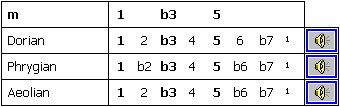
Although they are not modes of the Major scale, don't forget that you can also use the Melodic Minor and Harmonic Minor scales over a minor chord (because they also both contain the 1-♭3-5 degrees). We will look at this again in a later topic.
The diminished (dim) triad chord, with degrees 1-♭3-♭5 is less commonly used, and has only one suitable mode, the Locrian.

Now, let's try a few common four-note chords. Because we need to find all four notes in the modes, the choice is more restricted, and the essential harmonic nature of each scale mode becomes more apparent.
We'll start with the dominant seventh (7), which has degrees 1-3-5-♭7. We find only one Major scale mode, the Mixolydian.

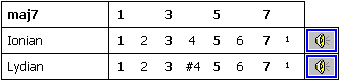
Two other common four-note chords are the major seventh (maj7) with degrees 1-3-5-7, and the minor seventh (m7) with degrees 1-♭3-5-♭7. Suitable modes for both of these are shown below.
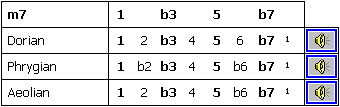
Although the use of the Major scale modes should be starting to get clearer now, you may still be a little overwhelmed at the thought of having to learn so many scale modes. Well, you don't have to learn them all at once.
In fact, you can often get by quite nicely with just three of them: Ionian for major-based chords; Dorian for minor-based chords; and Mixolydian for dominant seventh-based chords.
Once you've got these sorted, you will already have an effective improvising tool kit under your belt. You can then introduce the others at your leisure, to iron out harmonic wrinkles in your improvisation and explore other melodic moods.

In most ChordWizard products, the Relations View or the popup Relations tool can instantly show you the full set of relationships between all chord types and all scale types.
|
Topic 102 of 117
| ||
Bring these music concepts to life with the free Songtrix Bronze Edition as you create songs from chords and scales.
Then publish and share your ideas with the other musicians you meet on the ChordWizard Network.
Have questions? Join the ChordWizard Network and post them in the Music Theory forum for answers and discussions on your topics of interest.