
(8.9) Melodic Minor Scale Modes
As the foundation of western music, the Major scale and its modes predominate in improvisation. These seven modes cover many of the chords you will come across when improvising, but other scale types still have an important role to play.
For example, there are several chord types (such as augmented chords) which are not compatible with any Major scale mode. Also, the distinctive sound of the other scale types can add richness to your playing, even where Major scale modes are possible.
The Melodic Minor scale is the next most useful in forming improvised melodies. Like the Major scale, it can also appear in seven different modes - each starting on a different note.
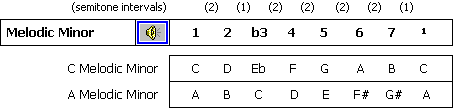
The Melodic Minor modes have less standardised names than the Major scale modes, so you may see some variations. Usually they are based on the name of the closest Major scale mode, with a suffix to indicate which degree is different.

For example, the second mode of Melodic Minor is the same as the Dorian scale (1-2-♭3-4-5-6-♭7) but the second degree is flat instead of natural, so it is called Dorian ♭2. This notation is actually quite helpful when learning them after the Major scale modes.





As with the Major scale, you can decide which modes are suitable for which chord types by finding the degrees of your chord type within them.
To improvise over an augmented chord (1-3-♯5) we can find three possibilities above. These are the Lydian ♯5, the Mixolydian ♭6 and the Super Locrian (since 3/♭4 and ♯5/♭6 are enharmonic equivalents of the same notes).

Most ChordWizard products contain all of the Melodic Minor scale modes within the standard scale types. These are activated at Intermediate and Advanced level (only available with Gold Edition products).
|
Topic 104 of 117
| ||
Bring these music concepts to life with the free Songtrix Bronze Edition as you create songs from chords and scales.
Then publish and share your ideas with the other musicians you meet on the ChordWizard Network.
Have questions? Join the ChordWizard Network and post them in the Music Theory forum for answers and discussions on your topics of interest.