
(9.3) Starting with Harmony
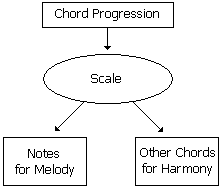
The first few chords of a progression are usually enough to give you a good idea of which scale the harmony might be in.
Once you have worked out the scale, this will tell you which notes you can use in the melody, and also which other chords are likely to work well with the song.
You can use the table below to help you find which Major scale (if any) contains the major (maj) or minor (m) chords in your progression. However, it cannot help you with other chord types or scale types.

Most ChordWizard products contain the Chords To Scales tool, which offers a much quicker and easier way to identify a scale from a chord progression than the manual method described in this topic.
You simply enter the chords in your progression, and you are instantly shown the related scales of all types and how closely they match.
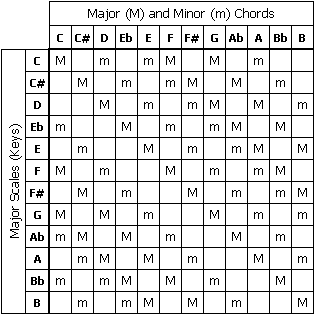
Step 1. Decide which chords are in your progression. Put them in order starting from root note C. You will be looking these up in the column headings.
Step 2. Work down the row headings in the table. Wherever a row contains an uppercase M in all the columns for your major chords, and a lowercase m in all the columns of your minor chords, this is a possible choice for the scale of your melody. Write it down.
Let's try this out with an example chord progression, shown below.

Step 1 tells us that our progression contains the chords Dmaj-Em-Am-Bm (in note order). Now following step 2, we work through each row in turn.
Row C: No (contains Dm, not Dmaj)
Row C♯: No (contains no D chords)
Row D: No (contains Amaj, not Am)
Row E♭: No (contains no D chords)
Row E: No (contains no D chords)
Row F: No (contains Dm, not Dmaj)
Row F♯: No (contains no D chords)
Row G: YES
Row A♭: No (contains no D chords)
Row A: No (contains Emaj, not Em)
Row B♭: No (contains Dm, not Dmaj)
Row B: No (contains no D chords)
We end up with just one choice for the scale of this chord progression, G Major. We can confirm this by playing the scale over the top of each chord in the progression, to make sure that it sounds compatible.

Knowing the scale of our new song tells us that our melody could use the notes G-A-B-C-D-E-F♯ (which are the notes of the G Major scale). It also highlights for us a group of other chords - the related chords of G Major - that are likely to work well with our song.
|
Topic 110 of 117
| ||
Bring these music concepts to life with the free Songtrix Bronze Edition as you create songs from chords and scales.
Then publish and share your ideas with the other musicians you meet on the ChordWizard Network.
Have questions? Join the ChordWizard Network and post them in the Music Theory forum for answers and discussions on your topics of interest.