

(9.5) Songwriting Example
To bring together the concepts of the last few topics, we are now going to follow through an example of using these techniques, starting with the following melody fragment:
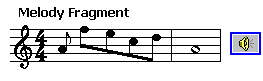
This melody contains the notes A-F-E-C-D. We first need to find the scale containing these notes. Using the lookup table and following the method in the earlier topic, we get the following results:
Row C: YES
Row C♯: No (does not contain D)
Row D: No (does not contain C)
Row E♭: No (does not contain E)
Row E: No (does not contain C)
Row F: YES
Row F♯: No (does not contain C)
Row G: No (does not contain F)
Row A♭: No (does not contain D)
Row A: No (does not contain C)
Row B♭: No (does not contain E)
Row B: No (does not contain C)
So our melody could be in the key of either C Major or F Major. Which one? As we did before, let's play the melody with the home chord of each key to see which one fits best.

There's not a lot of difference between the two possibilities, but the Fmaj chord does seem to fit more strongly with the melody.
We will therefore select the F Major scale, although the C Major scale would also be a reasonable choice, and would give us an alternative harmonic framework. Something to come back to, perhaps, if our first choice doesn't work out.
Now that we have decided on the scale, we know the full set of notes that we can use for making our melody. As well as A-F-E-C-D, the other notes of F Major are B♭ and G.
Knowing the scale also means that we can look at the related chords we have to choose from. Let's redraw the table in the previous topic to show the specific notes of the F Major scale.
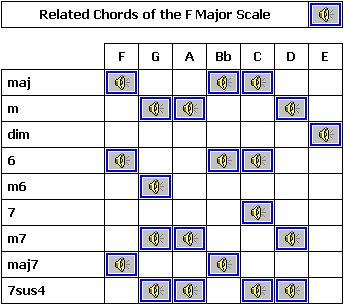
You can experiment with as many of these chords as you wish over the melody fragment we started with. Not all of them will fit, but the search has been narrowed down to the few most likely choices.
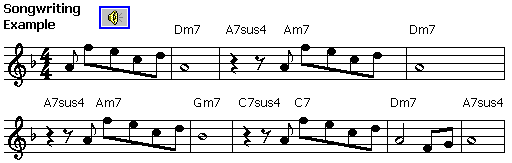
One set of chords which seems to work well is shown below. Because the tune seems to have a melancholy flavour to it, most of the chords we have chosen are minor-based.
In effect, we are viewing the F Major scale as a D Natural Minor. Notice the use of the F Major/D Minor key signature on the staff lines to indicate that a B♭ is played instead of a natural B.
(The music in this songwriting example is copyright © 2002 by Flexis Systems Pty Ltd)
|
Topic 112 of 117
| ||
Bring these music concepts to life with the free Songtrix Bronze Edition as you create songs from chords and scales.
Then publish and share your ideas with the other musicians you meet on the ChordWizard Network.
Have questions? Join the ChordWizard Network and post them in the Music Theory forum for answers and discussions on your topics of interest.